Instrument Close-Up
Have fun exploring the instruments used by the Kalamazoo Symphony Orchestra up-close! Learn about the four instrument families below, and meet the musicians who play in your Kalamazoo Symphony Orchestra! Be sure to visit us for a concert afterwards!
Sections:
Strings
String instruments are very carefully made and each one has over 70 parts! They produce music through their vibrating strings. There are bowed string instruments such as the violin, and plucked string instruments, like the harp. Learn more about the KSO Strings!
Violins
- Highest string sound (soprano)
- Held under chin
- Cost can range from a hundred dollars to millions of dollars
- 4 strings (G, D, A, E)
Viola
- Second highest string sound (alto)
- Held under chin
- 4 strings (C, G, D, A)
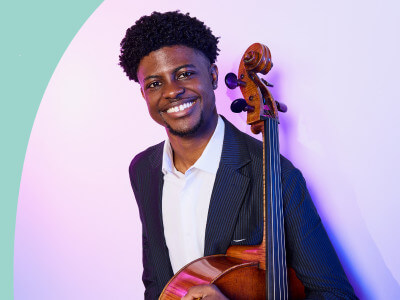
Cello
- Second lowest string sound (tenor)
- Peg at base of cello rests on floor
- supported between knees of player
- 4 strings (C, G, D, A)
Bass
- Lowest string sound (bass)
- Has sloping shoulders rather than round ones like the violin, viola, and cello
- Peg at base of instrument rests on floor
- Player stands behind the instrument or sits on a tall stool
- 4 strings (E, A, D, G)
Harp
- Has a 46-48 strings, a range of 6 ½ octaves (a group of 8 strings)
- Weighs 80 pounds
- Has pedals at the base that change the pitch of the strings
- Player sits behind and plucks the strings from either side with both hands
Woodwind
A woodwind instrument produces sound when the player blows air against a sharp edge or through a reed, causing the air inside the instrument to vibrate. Most are made of wood, but can be made of other materials, such as metals or plastics. Meet KSO's woodwind musicians!
Flute
- Highest sounding woodwind
- Originally made of wood
- Now made of silver, gold, or platinum
- Does not use a reed
- Piccolo is a smaller, higher pitched member of the flute family
Oboe
- Uses a reed made of two pieces of bamboo tied together (aka a double reed)
- Length is about 24"
- Medium-high pitch range
- Gives the tuning pitch for the orchestra because of its clear, steady sound
Clarinet
- Uses one thin, flat piece of bamboo (aka a single reed)
- Length is about 26.5"
- Medium-high to low pitch range
- Easily changes speed and volume
Bassoon
- Uses a double reed
- Stretched out, length is over 9 feet
- Low pitch range, similar to cello
- Expressive sound can communicate many different moods
Brass
A brass instrument produces sound through vibration of the player's lips into a mouthpiece which sets the air in motion. Brass instruments are also called labrosones, which means "lip-vibrated instruments." Most brass instruments use valves to change pitch. Learn about KSO's brass section!
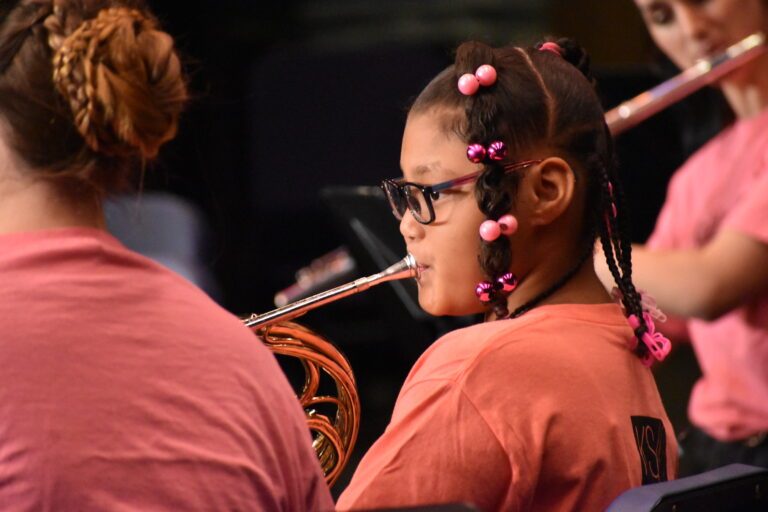
Horn
- Started out as a hunting horn
- Length is 17 feet uncoiled
- Medium-high range
- Hand is placed in bell (the large opening) to change tone and pitch
Trumpet
- Two trumpets are used in a quintet (a group of 5 musicians)
- Length is 6 feet uncoiled
- High range (soprano)
- Earliest versions were animal horns used 1,000 years ago
Trombone
- Uses a "slide" to change pitch
- Was once called a sackbut (French for "pull-push")
- Length is 9 feet uncoiled
- Medium low range (tenor)
Tuba
- Length is 14-18 feet uncoiled
- Weighs 20-38 lbs
- Types include a wrap-around Sousaphone for marching bands
- Low brass range (bass)
Percussion
A percussion instrument is any object which produces a sound by being hit with an object, shaken, rubbed, scraped, or by any other movement which makes a vibration. Learn about KSO's percussion musicians!
Timpani
- Also called kettledrum
- Definite pitch (tuned to an exact pitch)
- Played in groups of 3-5 drums
- Drum head, usually plastic, is stretched over copper kettle
- Drum head can be tightened to raise pitch
Snare Drum
- Indefinite pitch (not tuned to an exact pitch)
- Snares (wire strings) on bottom of drum head vibrate when drum head is hit
Bass Drum
- Large and low pitched
- Indefinite pitch (not tuned to an exact pitch)
Cymbals
- Two circular brass discs (flat, round circles)
- Indefinite pitch (not tuned to an exact pitch)
Xylophone, Vibraphone, Marimba
- Pitched instruments, played with mallets
- Bars (or "keys") of different lengths are hit to make different pitches
- The sound that the keys make depend on the material used
- Marimba has wooden keys; xylophone and vibraphone have metal keys
Other percussion instruments
- There are many other percussion instruments such as maracas, bells, gong, woodblock, whip, wratchet, large sheets of metal, and even trash cans!
- Each percussionist may play several different instruments during a single piece.